
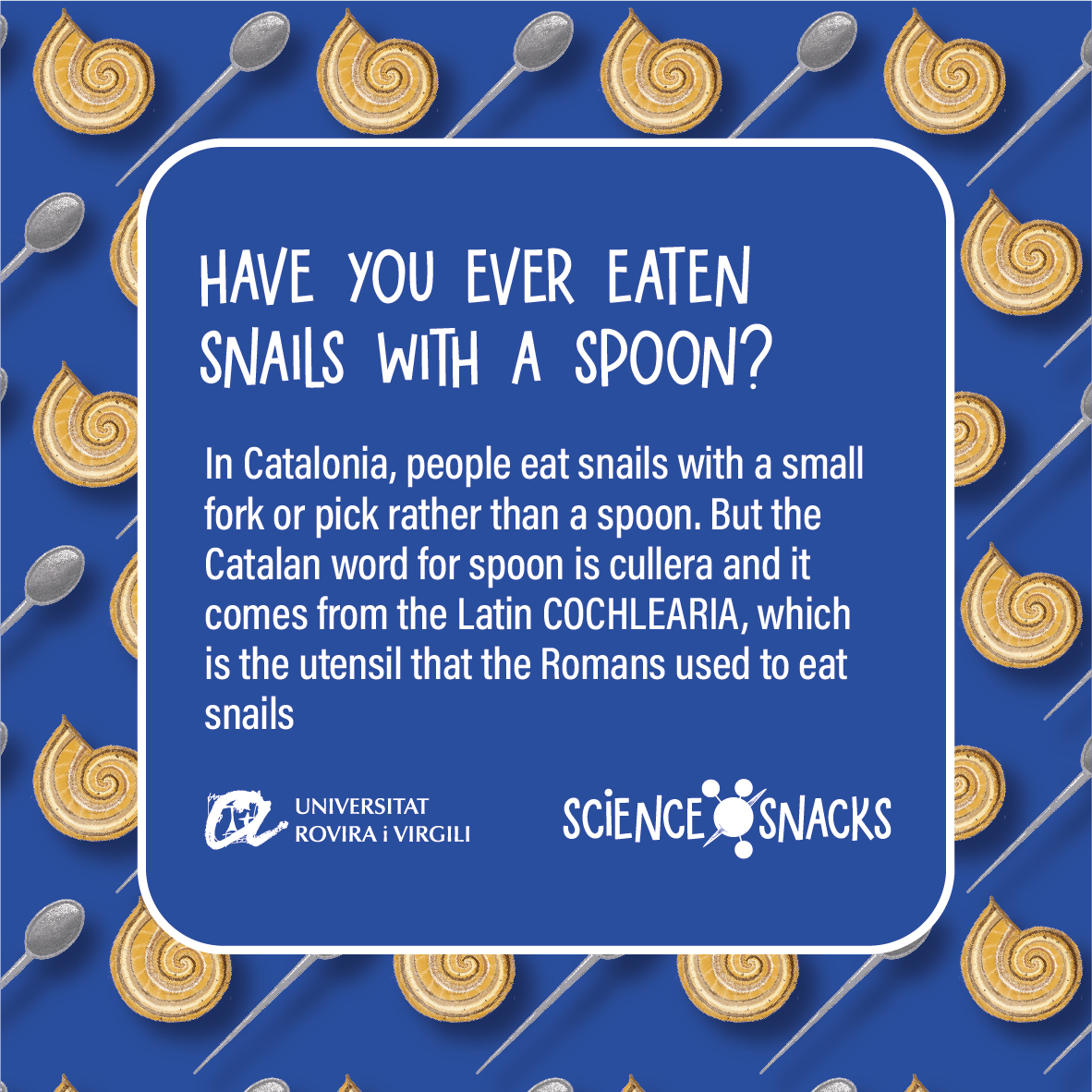
Have you ever eaten snails with a spoon?

Pere Navarro Gómez
Researcher at the Department of Catalan Philology
pere.navarro(ELIMINAR)@urv.cat
Have you ever eaten snails with a spoon? Not a typical question, it must be admitted, and one that rather suggests that the person asking it has lost their mind. Surely, no one scanning this QR code has ever eaten snails with such a utensil, but that is just how they were eaten in Roman times in Tarragona and throughout the empire. But, let's go back to the beginning.
It seems that snails were very much part of the diet of early humans, as can be inferred from fossil shells found in prehistoric caves. Much later, the Romans were great consumers of snails, even devising the first enclosures to rear them. Gaius Plinius Secundus (Pliny the Elder), a Roman writer, scientist, naturalist and military officer, author of the *Naturalis Historia*, explains that snails could be eaten roasted and marinated in wine.
It is also known that the harvesting of seafood, and oysters in particular, was an important economic activity in ancient Rome. This is demonstrated by the numerous excavations where shells of mussels, sea snails, tellins, scallops, oysters and cockles have been found. This culture of eating snails and seafood in general has survived to the present day. But what has not survived is eating them with a spoon.
Again the archaeological record shows that humans have been eating with spoons since the Stone Age. The spoons of the ancient Romans could be made of wood, horn or metal and were given the ancestral name LIGULA or LINGULA. In contrast to all the other Romance languages, only Romanian has retained the original Latin word with the same meaning: in Romanian, the word for 'spoon' is lingură.
As has already been mentioned, eating seafood was a popular activity in ancient Rome and led to the development, from the 1st century AD onwards, of a particular type of spoon with a pointed end to better extract the meat from snail shells - known as COCHLEA in Latin. Thus, in ancient Rome, two types of spoon were used: a larger one, called a LIGULA or LINGULA, and a smaller one called a LINGULA COCHLEARIA, meaning 'snail spoon'.
Obviously, this was a bit of a mouthful, so the noun LINGULA was soon dropped, leaving the adjective COCHLEARIA to act as a noun denoting a pointed spoon used for eating snails and shellfish. As a result, the word for "spoon" in nearly all modern Romance languages is derived from COCHLEARIA or COCHLEARIU, as can be seen in the list at the end.
In the Rhaeto-Romansh languages - Romansh, Ladin and Friulian - the influence of the Goths in the Alps from the 5th century led to the introduction of the word SKEIǷO to the north of the Italian peninsula, Latinised as SCETONE. This is the root of the words tschadun (Romansh), sciadon (Fassa Valley Ladin), sedon (Furlan). The form in Dolomitic Ladin is cazuel, of uncertain Mediterranean or Indo-European etymology < KATTIA.
In Sardinian, the use of the patrimonial variant cogarzu (which has come to mean 'shepherd's spoon') has been displaced in the centre and south of the island by cullera - a loanword from Catalan - and in the north by cucciarì - a loanword from Spanish cucharín < cuchara.
|
Latin |
COCHLEARIU/A |
|
Galician-Portuguese |
colher |
|
Asturian |
cuyar |
|
Spanish |
cuchara |
|
Aragonese |
cullara |
|
Catalan |
cullera |
|
Occitan |
culhièr |
|
French |
cuillère |
|
Walloon |
cwî |
|
Arpitan |
culyére |
|
Piedmontese |
cuciar |
|
Romansch |
tschadun |
|
Ladin |
cazuel, sciadon |
|
Friulian |
sedon |
|
Sardinian |
cogarzu |
|
Corsican |
cuchjara |
|
Italian |
cucchiaio |
|
Neapolitan |
cucchiaro/a |
|
Romanian |
lingură |
|
Latin |
LINGULA |
Share


Con la financiación de: